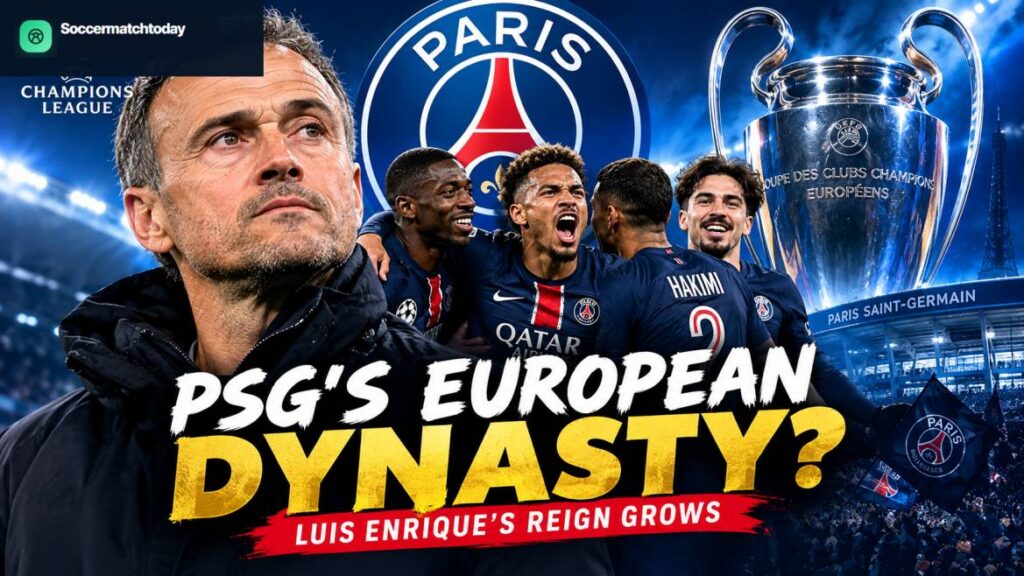
Paris Saint-Germain are no longer trying to prove they belong among Europe’s elite. The question is becoming considerably bigger: how far can this era of PSG dominance go?
Luis Enrique’s side produced another statement on Wednesday night, beating Manchester City 4-2 at the Etihad Stadium in the UEFA Champions League and reminding Europe why the holders are legitimate contenders to win the competition for a third consecutive season.
PSG were devastating during the first half. Désiré Doué opened the scoring in the 13th minute, Ousmane Dembélé added another just two minutes later and Vitinha made it 3-0 before half-time. City responded through two Erling Haaland goals after the interval, but Maghnes Akliouche also scored for PSG as the visitors survived Manchester City’s improved second-half performance and left England with another major European victory.
Former England striker Chris Sutton described PSG as operating on a “different level” during BBC Radio 5 Live’s coverage, and the wider discussion after the match quickly moved beyond one result.
PSG have already won the last two Champions League titles.
They destroyed Inter Milan 5-0 in the 2025 final.
They retained the trophy by defeating Arsenal on penalties in Budapest in May 2026.
Now they have started another European campaign with the possibility of doing something only the greatest sides in the competition’s history have achieved.
A third straight Champions League would not simply establish PSG as the dominant European team of the moment.
It would place them alongside some of the most celebrated dynasties European football has ever produced.
SoccerMatchToday readers can follow the tournament through the UEFA Champions League, and track current games through the live football scores.
PSG Tore Manchester City Apart Before Half-Time
The scoreline alone does not fully explain how impressive PSG were during the opening period at the Etihad.
Manchester City entered the match as Premier League leaders and had been enjoying an excellent start under Enzo Maresca.
PSG nevertheless made them look unusually vulnerable.
Doué’s opener arrived after only 13 minutes.
Dembélé struck again almost immediately.
By the time Vitinha made it 3-0 after 32 minutes, City were facing a situation rarely seen at their own stadium.
PSG moved the ball quickly, attacked the spaces created by City’s press and repeatedly produced overloads before the home side could reorganise.
This was not simply a team defending deep and exploiting counterattacks.
PSG were prepared to play.
They trusted their technique under pressure.
They progressed through midfield.
And once they reached the final third, the speed of their combinations made City’s defensive structure look fragile.
That first half was perhaps the clearest explanation for why conversations about a PSG dynasty have become serious.
Manchester City Showed Why PSG Are Not Invincible
There is an important counterpoint.
The second half was very different.
City attacked aggressively after the restart, and Haaland scored twice.
The home side eventually registered 27 shots, spending long stretches forcing PSG backwards. Enzo Maresca argued afterwards that his side had shown it was closer to PSG’s level than the first-half score suggested.
That matters when judging PSG.
They were magnificent.
They were not flawless.
Luis Enrique’s side still had periods where City exposed them, and the match might have become significantly more uncomfortable had the Premier League champions converted more of their second-half opportunities.
But this is another characteristic of elite tournament teams.
They do not need every phase of a major away match to be perfect.
They need to make their strongest periods count.
PSG did.
Akliouche’s Goal Killed Manchester City’s Momentum
Haaland’s first goal arrived in the 53rd minute and gave City hope.
The Etihad responded.
The intensity increased.
For a few minutes, it appeared possible that the match could turn into one of those famous European comebacks.
Then Maghnes Akliouche struck in the 62nd minute.
PSG suddenly had their three-goal advantage again.
Haaland scored his second in the 75th minute, but by then City were chasing a mountain that had become too steep.
PSG even had the opportunity to score a fifth late on, although Matvey Safonov’s former City counterpart Gianluigi Donnarumma, now playing for Manchester City, saved the penalty.
The key was not that PSG completely stopped City from attacking.
They did not.
It was that every time the match threatened to shift, PSG had enough attacking quality to punish another mistake.
That is what champions do.
Back-to-Back European Champions Are Already Rare
The historical context makes PSG’s current position extraordinary.
In May, PSG defeated Arsenal on penalties after a 1-1 draw to retain the Champions League.
That made them only the second club to defend the trophy successfully in the Champions League era, following Real Madrid.
Modern European football is designed to make sustained domination difficult.
Domestic champions face elite opponents almost every round.
Squads change.
Managers leave.
Players become injured.
Opponents adapt tactically.
The margins in knockout football are tiny.
That explains why so many outstanding teams have won one Champions League and then failed to retain it.
PSG have already overcome that barrier.
The next one is even more significant.
A Third Champions League Would Put PSG in Extremely Rare Company
Only a tiny group of sides have won Europe’s premier competition three consecutive times.
Real Madrid won the first five European Cups from 1956 to 1960.
Ajax won three straight between 1971 and 1973.
Bayern Munich followed immediately with three between 1974 and 1976.
Real Madrid then became the first—and so far only—team in the modern Champions League era to win three consecutively, doing so from 2016 to 2018.
If PSG win again in 2027, they would become only the fourth club ever to win three consecutive European Cups or Champions Leagues, and only the second club to achieve the feat since the competition was rebranded in 1992.
That is the level of history currently available to Luis Enrique’s team.
PSG’s Transformation Started With Moving Away From the Superstar Model
Perhaps the most interesting part of PSG’s rise is how different this team looks from previous versions of the club.
For years, PSG attempted to win the Champions League by assembling extraordinary individual talent.
Zlatan Ibrahimović.
Neymar.
Lionel Messi.
Kylian Mbappé.
Ángel Di María.
Edinson Cavani.
The quality was unquestionable.
The European trophy remained elusive.
Luis Enrique changed the emphasis.
Following Mbappé’s departure, PSG increasingly moved away from constructing the side around one superstar and towards a collective tactical structure in which every player was required to contribute with and without the ball.
Reuters described the transformation ahead of the 2025 Champions League final as a move away from a player-centric culture and towards a more disciplined, collective system.
That shift proved decisive.
PSG immediately won Europe’s biggest trophy.
Then they won it again.
Luis Enrique Has Become PSG’s Central Figure
Modern PSG revolve less around one superstar footballer and more around the coach.
That is an important change.
Luis Enrique dictates the playing style.
He controls the tactical expectations.
And the squad has increasingly been recruited to fit those principles.
That creates continuity.
A winger can leave and another can enter without the entire system needing to be rebuilt.
A midfielder can be rotated without PSG abandoning their identity.
The Spanish coach has now won three Champions League titles overall after his previous triumph with Barcelona in 2015. UEFA notes that he became only the fifth coach to win the European Cup or Champions League at least three times.
His legacy at PSG is already secure.
A third consecutive European championship would elevate it into something far more significant.
The 2025 Champions League Win Changed Everything
PSG’s first Champions League triumph removed a psychological burden that had followed the club for years.
They did not simply beat Inter Milan in the final.
They won 5-0.
It was a performance that announced a complete change in status.
PSG were no longer the wealthy club trying to win Europe.
They were European champions.
That distinction matters psychologically.
Once a team has won the competition, players approach difficult knockout situations differently.
They possess evidence that their methods work.
They have experienced the pressure.
They understand how to survive bad moments.
And opponents begin treating them differently.
Retaining the Trophy May Have Been Even More Impressive
Winning the first Champions League answered one question.
Winning another created a completely different level of credibility.
The 2025/26 campaign included significant challenges.
PSG had to survive Monaco.
They then dismantled Chelsea 8-2 on aggregate.
Liverpool were beaten 4-0 across two legs.
Bayern Munich pushed PSG through a dramatic 6-5 aggregate semi-final before Luis Enrique’s team reached Arsenal in Budapest.
The final finished 1-1 before PSG won the shootout 4-3.
That route matters.
This was not a soft path towards another trophy.
PSG repeatedly eliminated elite opposition.
The Attack No Longer Depends on One Player
One of PSG’s greatest strengths is the distribution of attacking responsibility.
Khvicha Kvaratskhelia scored 10 Champions League goals in 2025/26.
Ousmane Dembélé scored eight.
Vitinha scored six.
Désiré Doué added five.
PSG became the team with the highest number of players scoring at least five goals in that Champions League campaign.
That makes preparation difficult for opponents.
Stopping one player is not enough.
Double-mark Kvaratskhelia and Dembélé receives more room.
Protect against Dembélé and Doué can attack another space.
Push too aggressively towards the forwards and Vitinha can exploit openings from midfield.
PSG’s offensive threat is structural.
That is considerably more difficult to neutralise than an attack organised primarily around one scorer.
Désiré Doué Represents the New PSG
Doué may be the player who best represents how the club has changed.
He is young.
Technically exceptional.
Positionally flexible.
And comfortable playing inside an aggressive collective system.
His goal at the Etihad was another reminder that PSG’s biggest moments no longer belong exclusively to established superstars.
Younger players are trusted to decide major Champions League matches.
The same applies to academy graduates and other developing players integrated into the first-team structure.
PSG’s 2025/26 Champions League-winning squad had an average age of 24 years and 221 days, making them the third-youngest winners in competition history.
That age profile matters when discussing a potential dynasty.
This is not an old team attempting one final run.
Many of its central players could remain together for several seasons.
Kvaratskhelia Has Developed Into a Champions League Reference Point
Khvicha Kvaratskhelia was named UEFA’s Champions League Player of the Season for 2025/26 after producing 10 goals and six assists during PSG’s successful title defence.
His presence gives Luis Enrique something every dynasty needs: a player capable of breaking a tactical stalemate individually without forcing the entire team to become dependent on him.
That balance is extremely difficult to achieve.
Great teams require individuality.
They simply cannot allow individuality to become the entire tactical plan.
PSG appear closer to that balance than at any previous stage of the QSI era.
Dembélé’s Evolution Has Been Equally Important
Ousmane Dembélé’s transformation has become another example of Luis Enrique’s influence.
For much of his Barcelona career, the discussion around Dembélé focused on injuries, inconsistency and unrealised potential.
At PSG, his role has become clearer.
He can move centrally.
He can create from wide positions.
He can press.
He can combine in tight spaces.
And he can score.
Luis Enrique’s collective structure appears to have given Dembélé enough freedom to use his unpredictability without allowing that unpredictability to destabilise the team.
Against City, he scored PSG’s second goal only two minutes after Doué’s opener.
It was exactly the type of sequence that makes the current side so difficult to contain.
Vitinha Gives PSG Control
The spectacular attacking players naturally attract more attention.
But PSG’s capacity to become a long-term European power may depend just as heavily on midfield.
Vitinha has become central to how Luis Enrique’s side manage possession.
He can receive pressure.
He can control the tempo.
He can progress the ball.
And he can attack space when opponents become overly focused on PSG’s forwards.
His goal against City was a perfect example.
When PSG’s movement drags defenders towards the front line, midfielders are capable of exploiting what opens behind them.
That gives the attack multiple layers.
PSG Have Depth as Well as a Strong Starting XI
Dynasties usually require more than 11 great players.
They need depth.
Suspensions arrive.
Injuries happen.
Domestic schedules create fatigue.
A Champions League run can extend deep into May while league and cup commitments continue simultaneously.
PSG increasingly appear equipped for that problem.
Their 2025/26 season produced 29 goals from substitutes across all competitions, the highest total among clubs in Europe’s top five leagues according to PSG’s end-of-season review.
That suggests replacements are not merely preserving games.
They are changing them.
For a team attempting three consecutive European titles, that difference is enormous.
Their Domestic Start Shows Why the Dynasty Question Still Needs Caution
It would nevertheless be premature to crown PSG as the greatest European dynasty already.
Their start to the 2026/27 Ligue 1 campaign has been uneven.
Before the Manchester City match, PSG had collected 11 points from six league games and sat fifth, having just beaten Le Mans 3-1.
That does not undermine what they have achieved in Europe.
But dynasty discussions should involve sustained dominance across an entire period rather than a handful of exceptional Champions League nights.
Real Madrid’s great sides did it repeatedly.
Ajax changed how football was understood.
Bayern won Europe three years running with a core that also powered West Germany.
Pep Guardiola’s Barcelona influenced an entire generation of coaching despite winning only two Champions Leagues during his four-year spell.
Greatness is measured through more than trophies alone.
The Greatest Dynasties Usually Change Football
This is the hardest standard for PSG to meet.
Winning is one requirement.
Influence is another.
The Real Madrid side of Alfredo Di Stéfano and Ferenc Puskás helped establish the European Cup itself as the defining club competition.
Ajax’s three consecutive titles became inseparable from Total Football.
Bayern’s 1970s team featured Franz Beckenbauer, Gerd Müller and Sepp Maier at the centre of both club and international dominance.
AC Milan under Arrigo Sacchi transformed pressing and defensive organisation.
Barcelona under Guardiola turned positional football into the dominant tactical reference point of an era.
Real Madrid’s 2016-18 side created its own Champions League mythology through three consecutive titles.
PSG still have time to establish what their broader legacy will be.
What Makes This PSG Team Different From Past Champions?
There are already characteristics that distinguish them.
Their pressing is aggressive without being permanently reckless.
Their attackers interchange positions constantly.
Their midfielders are technically secure enough to receive under intense pressure.
Their full-backs provide both width and progression.
And Luis Enrique demands defensive participation from players regardless of reputation.
The result is a team capable of attacking with freedom without appearing tactically loose.
That combination explains why they can produce a first half like the one at Manchester City.
Every player appears to know the spaces around him.
The football looks spontaneous.
The structure beneath it is not.
The Biggest Difference May Be Mentality
There was a period when difficult Champions League moments seemed to affect PSG disproportionately.
A lead would disappear.
One mistake would create panic.
A hostile away stadium could change the match.
The current team appears different.
Winning twice has helped.
When Manchester City scored early in the second half on Wednesday, PSG did not collapse.
When the Etihad crowd became louder, PSG found another goal.
When City continued attacking, the holders survived.
That is not tactical brilliance alone.
It is a tournament experience.
Real Madrid Remain the Benchmark
Any conversation about Europe’s greatest dynasty eventually reaches Real Madrid.
Madrid have won a record 15 European Cups and Champions Leagues.
They won the first five editions.
They later won another three consecutively between 2016 and 2018.
No club has matched that overall relationship with the competition.
PSG cannot approach that historical total anytime soon.
Their European trophy count currently stands at two.
So if the question is whether PSG already possesses the greatest European dynasty ever, the answer is premature.
If the question is whether they are building one of the strongest modern European dynasties, the evidence is becoming much more compelling.
A Third Straight Title Would Change the Conversation Completely
This is the central point.
Two consecutive Champions Leagues place PSG in extremely rare territory.
Three would change how this team is remembered.
At that stage, comparison with Real Madrid’s 2016-18 side would become unavoidable.
The discussion would no longer concern whether PSG belongs among Europe’s great teams.
It would concern where they rank among them.
That is an extraordinary shift for a club that entered 2025 still waiting for its first Champions League title.
Barcelona Are Already Waiting
The calendar offers PSG little time to enjoy the City result.
After a Ligue 1 trip to Strasbourg on October 17, Luis Enrique’s side host Barcelona in the Champions League on October 20. PSG’s official schedule confirms the two fixtures as the next major tests.
That Barcelona game should provide another useful measure.
City challenged PSG physically and with attacking volume.
Barcelona will test their positional discipline and technical control differently.
If PSG continue producing results against Europe’s strongest teams, talk of another Champions League title will become increasingly difficult to dismiss.
The wider French campaign can also be followed through SoccerMatchToday’s football leagues, and football standings centre.
PSG Have Become the Team Everyone Else Must Solve
This may be the clearest sign of their transformation.
For years, PSG entered the Champions League asking whether they were capable of beating the established European powers.
Now the established European powers are asking how to beat PSG.
Manchester City could not solve them before half-time.
Liverpool could not score against them across two quarter-final legs last season.
Chelsea conceded eight over two games.
Bayern pushed them close but could not eliminate them.
Arsenal took the final to penalties and still lost.
That is what European authority looks like.
Are PSG Building Europe’s Greatest Dynasty?
They are building a European dynasty.
Calling it the greatest already would go beyond what the record supports.
Real Madrid’s five consecutive European Cups remain unmatched.
Ajax and Bayern both completed historic three-peats.
AC Milan’s late-1980s and early-1990s sides reshaped European football.
Guardiola’s Barcelona remain one of the sport’s tactical reference points.
Real Madrid then won the Champions League three years consecutively in the modern era.
PSG have two.
But the direction is unmistakable.
Luis Enrique has transformed the club from a collection of expensive stars into an elite collective.
The squad is young enough to remain competitive for years.
Responsibility is spread across several match-winners.
And the group now possesses something PSG spent years trying to purchase but could never guarantee:
European authority.
The 4-2 victory over Manchester City was not the beginning of that transformation.
It was another confirmation of it.
PSG are now attempting to become the first side since Real Madrid in 2018 to win three consecutive European titles.
If they succeed, there will no longer be any debate over whether this is one of the defining teams of the modern era.
The debate will be about how high they belong among the greatest European club sides ever assembled.