
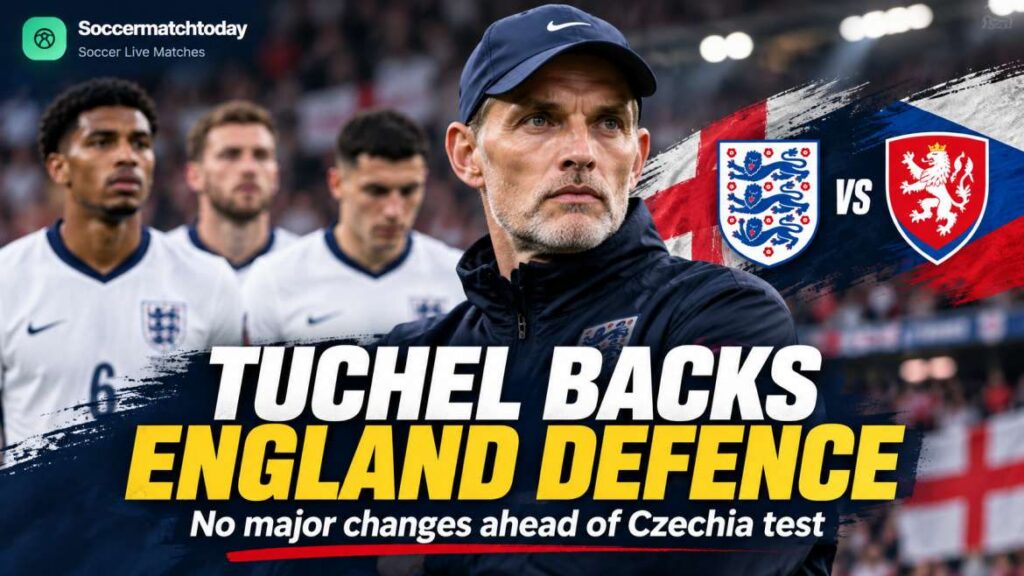
Thomas Tuchel has rejected calls for a major defensive reshuffle as England prepare to face Czechia in Prague, insisting the mistakes that cost his side against Spain were individual errors rather than evidence of a deeper structural problem.
England opened their 2026/27 UEFA Nations League campaign with a 3-2 defeat to world champions Spain at Wembley, where errors from Marc Guéhi and Nico O’Reilly directly contributed to two of Spain’s goals. Despite those costly moments, Tuchel said he was encouraged by England’s defensive organisation and does not intend to abandon players who have otherwise performed reliably for him.
The England head coach is therefore expected to favour continuity when the Three Lions meet Czechia at the Fortuna Arena on Tuesday, September 29, although injuries could force some changes.
Supporters following the international window can check SoccerMatchToday’s today’s football fixtures and live football scores as England’s Nations League campaign develops.
Tuchel Says England’s Problem Was Individual Errors, Not the Defensive System
The 3-2 defeat to Spain inevitably raised questions about England’s defence.
Spain scored after only two minutes when Guéhi was caught in possession deep inside his own half, allowing Lamine Yamal to capitalise.
England responded impressively.
Anthony Gordon equalised in the 36th minute before Harry Kane headed Tuchel’s side ahead four minutes later.
England then had an opportunity to establish a two-goal advantage after the break, but Kane slipped while taking a penalty and struck the crossbar.
Spain eventually punished them.
Alex Baena equalised after O’Reilly misplaced a pass, before Mikel Oyarzabal produced the decisive goal in the 74th minute.
For Tuchel, however, the way those goals developed is crucial.
He does not believe England were repeatedly being opened up because the defensive shape was fundamentally flawed.
Instead, he said the biggest problems occurred when England had possession and made avoidable mistakes around their own penalty area.
That interpretation explains why he is resisting drastic changes.
Tuchel believes the defensive block itself was more disciplined and cohesive than it had been during parts of the World Cup.
England Have Gone Six Games Without a Clean Sheet
The concern is understandable because England’s clean-sheet record has deteriorated.
The Guardian reports that Tuchel’s side will arrive in Prague having gone six consecutive matches without keeping a clean sheet.
That is unusual for an England team that has often relied heavily on defensive control in major tournaments.
But clean-sheet statistics alone do not explain the quality of the defending.
Against Spain, Tuchel felt England maintained their organisation for extended periods.
He highlighted the team’s ability to move forward from a middle block, avoid becoming permanently trapped in a deep defensive shape and retain their basic structure even when Spain controlled possession.
That is why he does not want one difficult evening to trigger wholesale changes.
There is a difference between a defence that is repeatedly being tactically exposed and one that is being punished for isolated individual mistakes.
Tuchel currently believes England’s problem is closer to the second category.
Marc Guéhi Retains Tuchel’s Trust
Guéhi’s early mistake against Spain was particularly damaging.
England were trying to establish themselves against the world champions when the defender lost possession in a dangerous area.
Spain punished the error immediately.
Tuchel nevertheless appears unwilling to respond by dropping him.
The England manager’s argument is straightforward: players should not lose their place solely because of one mistake if their broader performances remain strong.
That approach could prove important for Guéhi’s confidence.
Central defenders are frequently placed in situations where one error becomes far more visible than several successful defensive actions.
If Tuchel believes Guéhi remains suited to England’s system, removing him immediately after the Spain defeat could create greater instability rather than solving it.
The challenge for Guéhi is now to justify that trust in Prague.
Nico O’Reilly Faces a Fitness Test
The situation involving Nico O’Reilly is slightly different.
His misplaced pass contributed to Spain’s equaliser, but there is also uncertainty over his fitness ahead of the Czechia match.
Tuchel confirmed that both O’Reilly and Ezri Konsa are injury doubts, which could force England into changes regardless of the manager’s preference for continuity.
If O’Reilly cannot play, Newcastle United defender Lewis Hall is in contention to start at left-back.
That would represent a personnel change rather than a change in England’s overall defensive philosophy.
Hall offers different qualities in possession and could provide natural width from the left, but Tuchel’s basic structure is unlikely to be transformed simply because one full-back replaces another.
That distinction matters.
The manager is not saying England’s starting XI must remain completely unchanged.
He is saying that one defeat should not cause England to discard the defensive principles they have been developing.
Ezri Konsa’s Fitness Could Open the Door for Trevoh Chalobah
Konsa is another player whose availability will be assessed.
If the Arsenal defender cannot play, Trevoh Chalobah could compete with Jarrad Branthwaite for the place alongside Guéhi.
Tuchel therefore has several options.
He could maintain the same general structure while changing one centre-back.
He could give Branthwaite an opportunity.
Or he could turn to Chalobah, who already understands many of Tuchel’s defensive expectations from their previous work together at club level.
The choice may depend as much on physical condition as tactical preference.
England are playing four Nations League fixtures during an unusually long international window, beginning with Spain before trips to Czechia and Croatia and then another meeting with Czechia at Wembley.
Managing availability will therefore become increasingly important.
Trent Alexander-Arnold Is Pushing for a Return
Perhaps the most interesting selection question concerns Trent Alexander-Arnold.
The Real Madrid defender returned to the England squad for this international window after not being selected for the World Cup.
He was an unused substitute against Spain but could now challenge Jarell Quansah for the right-back position.
Tuchel has been impressed by Alexander-Arnold in training.
The England head coach said the former Liverpool defender had produced a particularly strong session after the Spain match and had demonstrated his desire to play.
Alexander-Arnold’s inclusion would alter England’s build-up options.
Few defenders possess his passing range.
From right-back, he can:
- switch play quickly;
- break midfield lines with longer passes;
- deliver accurately from deeper positions;
- create chances without needing to reach the final third.
Those qualities could be useful against a Czechia side expected to defend in an organised shape.
But Alexander-Arnold’s defensive positioning has been heavily scrutinised throughout his career.
That makes his possible return especially interesting at a moment when England’s defensive security is already under discussion.
Tuchel Wants England to Remain Proactive
Tuchel’s approach against Czechia is not expected to be cautious.
Despite losing the opening Nations League game, he has made clear that England will continue trying to play proactively.
He told reporters there was no room for an “economic” approach aimed simply at conserving energy.
Instead, England are expected to maintain intensity and attempt to impose themselves in Prague.
That philosophy fits the broader identity Tuchel has been trying to develop.
England want to press higher.
They want to push forward from defensive blocks.
They want to attack space quickly after winning possession.
And they want their defenders to be brave enough to participate in build-up play rather than immediately clearing the ball whenever opponents press.
The downside is obvious.
Greater ambition in possession creates more opportunities for mistakes.
The two errors against Spain demonstrated the risk.
Tuchel appears prepared to accept that risk if it ultimately produces a more assertive England team.
England Cannot Completely Separate Defence From Possession
This is perhaps the most important tactical point.
When Guéhi and O’Reilly made their mistakes against Spain, they were not attempting tackles or losing aerial duels.
They lost the ball.
That means England’s defensive problems cannot be considered entirely separately from their possession game.
If defenders are encouraged to build from the back, the quality of their decisions under pressure becomes part of defending.
A misplaced pass near the opposition penalty area is usually recoverable.
A misplaced pass near your own penalty area can immediately become a clear scoring opportunity.
Spain exploited that brutally.
Tuchel therefore needs England to maintain their bravery without becoming careless.
That balance is much harder to achieve than simply instructing defenders to take fewer risks.
James Trafford Will Start Again in Goal
One position Tuchel has already clarified is goalkeeper.
James Trafford will continue against Czechia, despite England conceding three goals against Spain.
The decision is not based on dissatisfaction with Jordan Pickford.
Tuchel has said there was no performance-based reason to remove England’s established No.1.
Instead, the Nations League provides an opportunity to assess whether another goalkeeper can function effectively within England’s system.
Trafford started against Spain and will receive another test in Prague.
Pickford is then expected to return for the trip to Croatia and the home match against Czechia.
That is a sensible use of the competition.
International managers rarely have opportunities to test alternative goalkeepers in genuinely competitive matches without the pressure of a major tournament.
Tuchel wants to know what England have behind Pickford before an injury or suspension forces the question unexpectedly.
Tuchel Rejects Calls for Heavy Rotation
The defensive debate is also connected to the wider issue of player rotation.
England’s international window contains four competitive matches between September 26 and October 6.
Several players also had shortened summer breaks because of the World Cup.
That has produced suggestions that Tuchel should rotate heavily.
He disagrees.
Tuchel described the idea of allowing clubs or players to select which England matches they participate in as “madness” and said he wants a core group of six or seven players to start repeatedly so they feel responsibility and trust.
That philosophy helps explain the defensive continuity.
Constant changes can protect players physically.
They can also prevent partnerships from developing.
Defenders rely heavily on familiarity:
knowing when a teammate will step forward, when the full-back will cover inside, when the goalkeeper will come off his line and when the midfield screen will drop.
England have already experienced substantial turnover at the back.
Tuchel appears to believe another round of unnecessary changes could make those relationships weaker rather than stronger.
Czechia Present a Different Challenge From Spain
England should not expect Tuesday’s match to resemble the Spain game.
Spain are world champions and one of the strongest possession teams in international football.
Czechia are likely to present a more structured and physically demanding challenge.
Tuchel described Santi Denia’s side as “very organised” in their opening Nations League defeat to Croatia.
Czechia lost that match 2-1.
Luka Modrić gave Croatia the lead shortly after half-time before Adam Karabec equalised. Marco Pašalić then scored the winner with 13 minutes remaining.
The result leaves both Czechia and England looking for their first points in Group A3.
That increases the significance of the Prague meeting even if Tuchel has resisted describing it as a must-win match.
Tuchel Says It Is Too Early to Call Czechia a Must-Win Game
England’s defeat against Spain immediately created pressure.
With only six matches in the Nations League group stage, losing consecutive games would leave the Three Lions with considerable ground to recover.
Tuchel nevertheless rejected the idea that Tuesday is already a definitive must-win fixture.
He acknowledged that the Spain defeat increased the pressure but argued that it remains too early in the campaign to frame the Czechia game in absolute terms.
Mathematically, he is correct.
England would still have four matches remaining after Prague.
But from a competitive perspective, another defeat would be damaging.
Spain and Croatia both began the group with victories.
England need to avoid allowing those teams to establish significant separation at the top.
England’s Record Against Czechia Is Strong, With One Important Warning
England have historically enjoyed the better record in this fixture.
According to official England Football statistics, the Three Lions have lost only one of their past nine meetings with Czechia in all competitions, winning six and drawing two.
However, that one defeat came on England’s last trip to Czechia.
In October 2019, the hosts won 2-1 in a European Championship qualifier.
That result provides a useful warning.
England’s superior player quality does not guarantee control in Prague.
Czechia also entered this international window with an impressive home record.
Their defeat to Croatia ended a 19-game unbeaten run at home, comprising 14 wins and five draws.
Tuchel is therefore right to expect a difficult evening.
Jude Bellingham Remains Central to England’s Attack
While much of the discussion has focused on defenders, England’s attacking performance against Spain contained encouraging signs.
Jude Bellingham continued his strong international form and won the penalty Kane later missed.
Official England Football statistics state that Bellingham has been involved in nine goals across his last nine England appearances, scoring seven and assisting two.
His ability to carry the ball through midfield will be particularly important against Czechia.
If the hosts defend compactly, England will need players capable of breaking lines rather than simply circulating possession around the outside of the defensive block.
Bellingham provides exactly that.
Anthony Gordon Strengthened His England Case Against Spain
Anthony Gordon was another major positive.
The Barcelona winger scored England’s first goal against Spain during a devastating transition, finishing an attack that reflected the direct style he has argued England should embrace more often.
His pace gives England a completely different threat from slower possession sequences.
Against Czechia, however, space behind the defence may be more limited.
That will test Gordon in another way.
He may have to beat defenders from a standing start rather than simply accelerating into open grass.
That makes Tuesday a useful measure of his development.
Harry Kane Will Want to Respond After the Missed Penalty
Kane’s performance against Spain contained both quality and frustration.
He scored England’s second goal to complete a rapid comeback.
He then had the opportunity to make it 3-1 from the penalty spot.
His standing foot slipped, and the ball struck the crossbar.
Spain eventually won 3-2.
The missed penalty therefore became one of the defining moments of the match.
Kane remains England’s captain and leading scorer, so there is little question about his position.
The more interesting issue is how England provide him with service against an organised Czech defensive block.
If Tuchel’s side dominate possession, Kane may need to drop deeper to connect attacks while Gordon, Bukayo Saka and other runners attack beyond him.
England Need Cleaner Decisions Near Their Own Box
Whatever defensive combination Tuchel selects, the central lesson from Spain is clear.
England cannot repeatedly give elite opponents possession in dangerous areas.
Against Czechia, the same mistakes may not automatically produce the same punishment.
That cannot become an excuse.
The purpose of the Nations League is partly to expose weaknesses before they become decisive at a European Championship or World Cup.
Tuchel has therefore resisted the easiest response.
He could change three defenders and present the new lineup as a solution.
Instead, he is asking the existing group to improve the decisions that caused the problem.
That places responsibility directly on the players.
Why Continuity Could Be the Right Response
There is logic behind Tuchel’s decision.
A manager who reacts to every individual error by changing the team risks creating fear.
Defenders start playing not to make mistakes.
They become less willing to receive possession under pressure.
They clear balls they would normally control.
And the team’s ability to build attacks from the back deteriorates.
Tuchel wants the opposite.
He wants England’s defenders to maintain confidence while becoming more precise.
If Guéhi responds with a strong performance in Prague, the decision to retain him will appear justified.
If the same types of mistakes continue, then the argument for changes becomes much stronger.
Czechia therefore provides both a Nations League challenge and a test of Tuchel’s judgment.
The Pressure Is on England to Turn Encouragement Into Points
Tuchel was positive about several aspects of the Spain performance.
England went toe-to-toe with the world champions.
They recovered from a disastrous start.
They created opportunities.
They briefly led.
But international football is ultimately decided by results.
England finished the evening with zero points
That makes Tuesday’s match significant.
The Spain performance can only remain encouraging if England build on it.
Another defeat, particularly one caused by similar defensive mistakes, would change the conversation quickly.
Tuchel Is Backing His Plan, Now England Must Prove Him Right
The message before Czechia is clear.
Thomas Tuchel does not believe England need a defensive reset.
He believes they need better execution.
The manager has defended Marc Guéhi and Nico O’Reilly, described the Spain goals as products of individual mistakes and praised the wider organisation of England’s defensive block.
Injuries may still force changes.
Lewis Hall could replace O’Reilly.
Trevoh Chalobah or Jarrad Branthwaite could feature if Ezri Konsa is unavailable.
Trent Alexander-Arnold is pushing strongly for a return at right-back.
James Trafford will remain in goal.
But the philosophy will remain.
England intends to be proactive.
They intend to play out from defence.
They intend to maintain trust in the players who made mistakes against Spain.
And they intend to pursue three points in Prague rather than respond to the opening defeat with caution.
That makes the Czech match an important test of England’s Nations League prospects.
It will show whether Tuchel’s faith in continuity can turn an error-strewn defeat into a more controlled performance only three days later.
For current match coverage, SoccerMatchToday readers can follow the live football scores, check the latest football fixtures and browse competition coverage through the football leagues section.